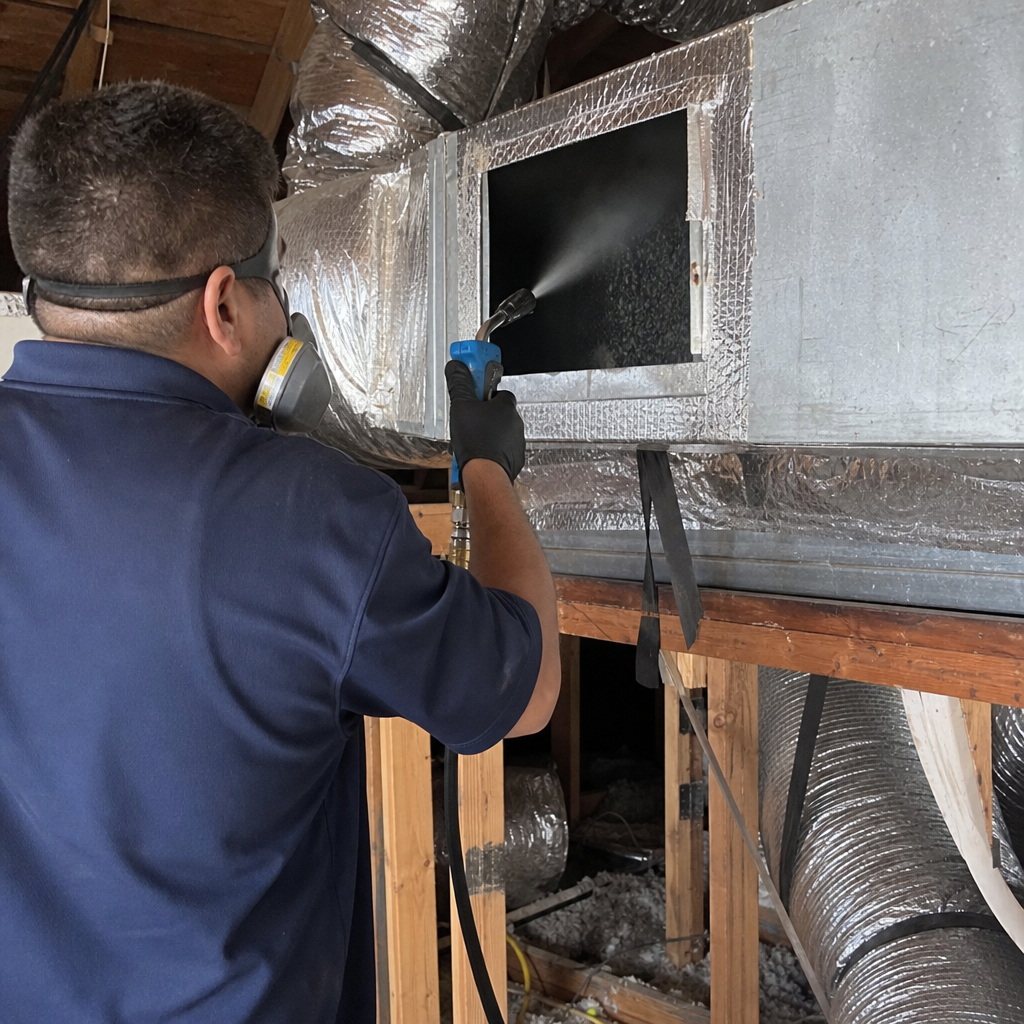
Fast, Reliable Air Quality & Sanitizing Across Watsonville
Air quality and sanitizing services in Watsonville typically cost between $350 and $850 depending on contamination severity, and most residential treatments are completed in a single day. For homes near active agricultural fields, we recommend combining duct cleaning with UV light installation to prevent recurring mold and bacterial growth.
We’ve been driving out to Watsonville from our San Jose base for years — down Highway 1 past Hecker Pass Road, through the strawberry fields that define this valley. We know the difference between a standard duct cleaning job and what Watsonville homes actually need. The agricultural particulate load here is unlike anything we see in San Jose or even coastal Santa Cruz. When Watsonville homeowners call us at (855) 677-0949, they’re usually dealing with that distinctive musty, earthy odor that signals agricultural dust has bonded with moisture inside their ductwork. Our Air Quality & Sanitizing team arrives with Rotobrush and Nikro equipment plus the Abatement Technologies HEPA systems built for this exact contamination profile.
Why Empire Air Duct Cleaning Service San Jose Is Watsonville’s Preferred Air Quality & Sanitizing Company
Our reputation in Watsonville was built job by job — not through advertising, but through results in neighborhoods like Freedom and along corridors like Airport Boulevard and East Riverside Drive. Nearly 800 customers across our service territory have left verified reviews, averaging 4.9 stars, and a growing share of those come from Watsonville homeowners who initially hired us for duct cleaning and returned for sanitizing after seeing what came out of their vents.
Response time matters when you’re dealing with active mold or bacterial contamination. We typically schedule Watsonville appointments within 2–3 business days, with emergency availability for severe contamination cases. Steven Ramirez, our owner and lead technician, personally performs the assessment and treatment — not a rotating subcontractor who doesn’t understand why a Freedom-area home from 1962 needs different handling than a 1990s tract house in San Jose.
That local knowledge is earned. We’ve crawled through attics in Watsonville where the original galvanized ductwork from the Eisenhower era connects to flex-duct repairs from the 1990s — patchwork systems created after the 1989 Loma Prieta earthquake forced partial rebuilds. We know where the agricultural dust concentrates, where the marine layer moisture creates biofilm, and which homes along Elkhorn Road and Hall Road need proactive UV installation before the next strawberry harvest cycle.
Our Air Quality & Sanitizing Services in Watsonville
Mold Treatment
Watsonville’s persistent marine layer from Monterey Bay keeps indoor humidity elevated for much of the year, and that moisture causes agricultural dust and organic debris inside ducts to clump and adhere to duct walls rather than pass through. This accelerates buildup and creates conditions favorable to mold and biofilm growth in a way that drier inland agricultural cities like Salinas do not experience to the same degree. Our mold treatment process begins with mechanical dislodging using hot-water-assisted Rotobrush agitation — standard dry brushing alone fails because the damp dust has hardened into a crust. We follow with Nikro HEPA vacuum extraction at 5,000 CFM, then apply botanical-based sanitizers that don’t introduce additional volatile compounds into your air stream. For Watsonville homes, we always verify complete surface dryness before closing access panels; residual moisture reactivates dormant spores within 48 hours.
Bacteria Sanitizing
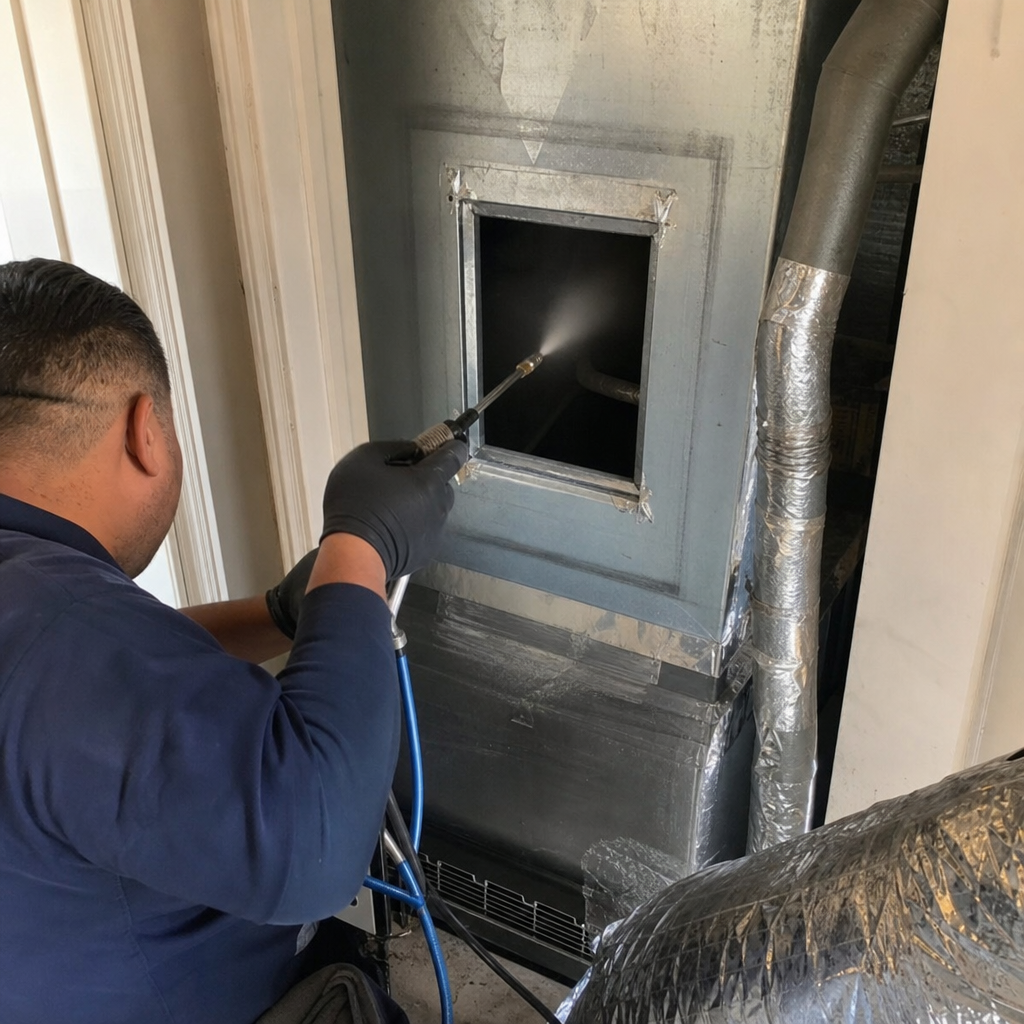
The same agricultural-dust-and-moisture synergy that feeds mold also supports bacterial colonies, particularly in homes with older ductwork that has never been cleaned. We use Abatement Technologies fogging systems with EPA-registered sanitizers, applied at calculated dwell times to penetrate the porous buildup that lines Watsonville duct interiors. This isn’t a surface spray — it’s a protocol developed for contamination loads that standard residential cleaning doesn’t address. After treatment, we verify air quality improvement with particle counters, not just visual inspection.
Odor Removal
The musty, earthy odor that Watsonville homeowners describe — often mistaken for “old house smell” — is typically volatile organic compounds released by microbial activity on agricultural particulate matter. Masking agents don’t work; the source has to be removed and the biological activity suppressed. Our odor removal protocol combines source extraction, sanitizing, and in persistent cases, activated carbon filtration or photocatalytic oxidation. For homes near active fields, we find odor recurrence drops dramatically when UV light is installed as a maintenance measure.
UV Light Installation
This is the service we push hardest for Watsonville. A properly sized Aprilaire or Honeywell UV-C system installed at the coil and return locations suppresses mold and bacterial regrowth by disrupting DNA replication. In Watsonville’s climate, it’s not optional if you want lasting results — the marine moisture will recontaminate sanitized ducts otherwise. We size systems based on your air handler’s CFM and duct dimensions, not generic wattage recommendations. Installation typically runs $450–$750 for residential systems, with lamp replacement every 12–18 months.
What happens when you call
- 1
A real person answersNo phone trees — you reach a local pro.
- 2
You get an upfront price rangeHonest numbers before anyone is dispatched.
- 3
A background-checked tech heads outLicensed & insured, dispatched right away.
- 4
You approve before work beginsNothing starts until you say go.
Trusted Brands We Service in Watsonville
We stock and install Honeywell, Aprilaire, and Abatement Technologies products for Watsonville jobs — brands with documented performance data, not generic chemicals repackaged for residential sale. For UV installation, we specify Aprilaire UV-C units with 17-inch lamp arrays for standard residential air handlers, or Honeywell 24V systems for variable-speed equipment. Our Abatement Technologies HEPA negative-air machines run on every sanitizing job, capturing 99.97% of 0.3-micron particles. We carry replacement lamps, filters, and sanitizing concentrates on our service vehicles, so Watsonville customers don’t wait for parts to ship from a warehouse. That matters when you’re treating active contamination — delays let microbial colonies reestablish.
Common Air Quality & Sanitizing Problems We See in Watsonville Homes
- Caked-on agricultural dust mixed with fungal biofilm. Standard sweeping alone fails; the material must be hot-water dislodged before HEPA vacuuming, or clumps break loose during airflow and re-contaminate downstream sections. We see this in virtually every Watsonville home that hasn’t been professionally cleaned within five years.
- Leaky duct joints from Loma Prieta-era patchwork connections. The 1989 earthquake forced partial rebuilds and repairs in many Watsonville structures, meaning some homes have patchwork duct systems combining older galvanized or flex duct segments with newer materials. These joints leak treated air and re-introduce untreated field particulates — requiring sealant and mastic tape after sanitizing, or the contamination cycle continues.
- Persistent marine moisture reactivating dormant spores within 48 hours. If duct surfaces are not completely dried and a UV light isn’t installed to suppress regrowth, Watsonville’s humidity ensures rapid recontamination. This is why we don’t offer sanitizing without drying verification, and why we strongly recommend UV for this climate.
- Multi-unit labor housing with shared duct systems and no maintenance history. Much of Watsonville’s mid-20th century residential stock includes multi-unit buildings where one contaminated system affects multiple households. We coordinate with property managers for comprehensive treatment, often working section by section to minimize tenant disruption.
Pricing for Air Quality & Sanitizing in Watsonville, CA
| Service | Typical Range in Watsonville |
|---|---|
| Bacteria Sanitizing (residential, up to 2,000 sq ft) | $350–$550 |
| Mold Treatment (moderate contamination, single system) | $550–$850 |
| UV Light Installation (single lamp, residential) | $450–$750 |
| Odor Removal Protocol (with extraction and sanitizing) | $400–$650 |
| Allergen Reduction Package (sanitizing + HEPA filtration upgrade) | $500–$800 |
What moves you within these ranges: square footage, contamination severity, accessibility of duct runs, and whether your system needs pre-cleaning before sanitizing can be effective. Homes along Elkhorn Road and Hall Road near active fields typically land in the upper half of ranges due to heavier particulate loads. We don’t quote over the phone for mold treatment — we need visual and moisture-meter assessment to specify the right protocol. Estimates are free. Call (855) 677-0949 to schedule.
We Also Serve Cities Near Watsonville
Our service radius covers the full Pajaro Valley and coastal corridor. We regularly treat air quality issues in Interlaken (where rural properties face similar agricultural exposure), Aptos and Rio Del Mar (coastal humidity without the heavy field particulate, but with their own mold pressures), and Capitola (older beach-area housing with salt-air corrosion of duct components). Each location gets the same owner-on-site treatment, with protocols adjusted for local conditions.
Serving Watsonville, CA — Our Local Coverage Area
We’re based in the Watsonville area and know this community well. Use the map below to see our service coverage — if you’re nearby, we can almost certainly help.
FAQs — Air Quality & Sanitizing in Watsonville
The strawberry harvest cycle releases elevated levels of pollen, crop dust, and pesticide drift that your HVAC system pulls in through outdoor air intakes and return leaks. In Watsonville, this agricultural particulate burden is trapped and concentrated inside ductwork by the damp marine layer, creating a contamination load that simply does not exist at the same scale in neighboring Santa Cruz or Capitola. We find the heaviest buildup in homes within a half-mile of active fields, particularly along corridors like Elkhorn Road and Hall Road. If you’re experiencing increased allergy symptoms during spring and summer harvest periods, your ducts are likely the distribution pathway. Call (855) 677-0949 for an inspection — estimates are free.
Yes — for two specific reasons that affect Watsonville homes uniquely. First, three decades of accumulated agricultural particulate in pre-1989 ductwork creates a contamination reservoir that standard cleaning may not fully address without hot-water dislodging and extended HEPA extraction. Second, many Watsonville homes received patchwork duct repairs after the earthquake, creating joints and gaps where dust accumulates and treated air escapes. We inspect for these legacy issues before quoting sanitizing work, because sealing those leaks is often necessary for lasting results. The age alone isn’t the problem — it’s what that age has allowed to accumulate, and how the repairs were executed.
Yes, a properly sized UV-C system is the most effective maintenance measure for Watsonville’s specific contamination profile. The musty smell comes from microbial volatile organic compounds released by mold and bacteria growing on agricultural particulate matter. UV light suppresses that biological activity continuously, preventing the odor generation at its source. We install Aprilaire and Honeywell UV systems sized to your air handler’s CFM, with lamp placement optimized for coil and return duct exposure. For Watsonville homes near active fields, we consider UV installation nearly essential if you want sanitizing results to last beyond the next humid season. Systems run $450–$750 installed.
We use Abatement Technologies HEPA negative-air equipment for extraction, and specify Aprilaire or Honeywell UV-C systems for ongoing microbial suppression. Our sanitizing solutions are botanical-based or EPA-registered formulations selected for efficacy against the specific mold and bacterial strains common in agricultural-dust-contaminated systems — not generic household disinfectants. We don’t use ozone generators for occupied residential treatment; the oxidation chemistry is too aggressive for sensitive individuals and provides no residual protection. For product questions specific to your system’s configuration, call (855) 677-0949.
We recommend scheduling between October and February, after the main strawberry and raspberry harvest cycles have concluded but before the heavy spring pollen season begins. This timing lets us remove accumulated agricultural particulate during lower-outdoor-load conditions, and gives UV systems time to establish microbial suppression before the next growing season. That said, we don’t delay treatment for active mold or bacterial contamination — if you’re experiencing symptoms now, waiting compounds the problem. Emergency scheduling is available for severe cases. Call (855) 677-0949 to discuss timing for your specific situation.
Written by Steven Ramirez, Owner at Empire Air Duct Cleaning Service San Jose, serving Watsonville and the Pajaro Valley since 2004.